

Changing your furnace filter regularly is one of the most important things for ensuring effective heating performance and keeping your energy bills in check. Not doing it often enough can lead to significant consequences in the near term and further down the road, such as increased breakdowns, expensive heating repairs, and the furnace failing sooner. By keeping up with this essential task, you can protect your furnace and make sure you get as much out of it as possible.
Recommended Furnace Filter Change Intervals
There’s quite a bit of conflicting information out there as to how often you should change a furnace filter. Some people say it’s something you should do monthly, while others say it’s only necessary to change the filter every three months or so. The primary reason for this discrepancy is that every HVAC system and every home is different. How quickly a filter gets dirty and starts becoming clogged also depends largely on how many hours the furnace runs each day. The type of filter you use and whether or not you have indoor pets make a difference as well. If you have pets and you don’t brush them frequently, quite a bit of pet hair can get drawn into the HVAC system through the return air vents and cause the filter to clog fairly quickly.
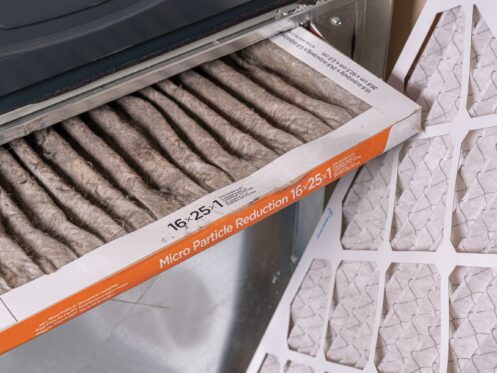
The best way to make sure that you never wait too long to change the filter is to pull it out and check it monthly to see how dirty it is. Once it starts looking gray, brown or black, it’s time to throw it out. You can also try holding it up to a light. You should normally be able to see some light through it. If you can’t, it means it’s fairly clogged and should be replaced.
Although the term “furnace filter” is commonly used, the term is slightly misleading. The more accurate term is HVAC air filter, as it also filters the incoming air when your central AC is running. As such, you need to make sure you keep up with checking it regularly and replacing it as needed throughout the year.
What Can Happen If You Don’t Change the Air Filter?
The dirtier an air filter gets, the more restrictive it becomes. In other words, the harder it is for the furnace blower to draw air through it. If the incoming airflow is restricted, the furnace obviously won’t put out as much hot air and thus won’t heat the house as quickly as it normally should. That means your heating bills will be higher as a result of your furnace having to run longer.
In cases where the filter is severely clogged, it can lead to almost no airflow coming out of the supply vents furthest away from the furnace at the ends of the various duct branches. That means those rooms will constantly be quite a bit colder than the more central parts of the house.
Another issue is that the blower has to work harder to pull in air through a dirty filter, which can sometimes result in it overheating and the HVAC system shutting down. The additional strain can also cause the blower to wear out and need replacing sooner.
The biggest concern is that a clogged filter can lead to the furnace itself overheating. Despite how incredibly hot the combustion fumes are when they flow through the furnace’s heat exchanger, the cooler air coming into the furnace normally keeps the heat exchanger from becoming too hot to where it becomes a potential safety hazard. However, the heat exchanger can quickly reach unsafe temperatures if the blower can’t pull sufficient cool air into the furnace because the airflow is restricted.
Overheating can do major damage to a furnace’s wiring and sensitive electronic components. In serious cases, the wiring could start to melt and lead to a fire. These risks are why modern furnaces have a safety mechanism known as a temperature limit switch that monitors the temperature inside the furnace and will shut it off immediately if the temperature reaches a set level. The limit switch is also what signals the blower to start running once it senses that the furnace is sufficiently hot.
You’ve probably noticed that the blower continues running for a couple of minutes after the furnace shuts off. This is because the limit switch doesn’t signal it to turn off until the temperature inside the furnace drops below a certain point. If the furnace overheats, the limit switch also won’t signal the blower to shut off until the furnace is sufficiently cooled to the point that it doesn’t pose any risks.
The thing you really need to worry about is if your furnace starts continually overheating. Frequent overheating can weaken the weld joints in the heat exchanger and cause it to crack, which can then potentially expose everyone in the house to deadly carbon monoxide.
How to Choose the Right Air Filter for Your Furnace
Using the right air filter can be just as important as making sure to change the filter often enough. If the filter isn’t efficient enough, lots of dust and other particles will pass through. This will result in the blower and other components getting overly dirty or becoming clogged. If the filter is too efficient for your HVAC system, it can restrict the airflow so much that it’s basically the same as running the system with a clogged filter.
MERV ratings are the standard way to express how efficient an air filter is. While 3M and Home Depot have their own rating systems, the packaging usually tells you what the filter’s rating is equivalent to on the MERV scale.
Standard air filters designed for use in residential HVAC systems typically have a range between MERV 5 and MERV 12. You can find cheap fiberglass or wire mesh filters that are under MERV 5, but they aren’t efficient enough to keep lots of dust from getting inside your HVAC system.
If your main concern is just keeping out dust and debris, a MERV 5 to MERV 8 filter will work just fine. If anyone in your household has allergies or asthma, you want to choose a filter with a higher MERV rating. Less efficient filters can only trap larger particles like dust, whereas higher-efficiency filters can also trap pollen, mold spores and other common household allergens and respiratory irritants.
Most newer furnaces can work with up to a MERV 10 filter without the airflow being restricted to the point where it causes any problems. Some units can still work fine with a MERV 12 filter. However, we recommend consulting with a certified technician before going any higher than MERV 10 just to make sure the filter isn’t too restrictive for your furnace. If you have an older furnace, you may not want to go any higher than MERV 8.
At George’s Air Conditioning, we’re proud to be the number one source for dependable heating and cooling solutions in Texas City. Since 1999, we’ve been helping home and business owners beat the Texas heat and humidity and keep warm throughout the winter. We offer free estimates on our services and are ready to put our expertise to work for all of your HVAC repair, maintenance and installation needs. For service that won’t disappoint, contact us today.